The Ancient Silk Road · Gaochang and Beyond
Han Dynasty
The rise of the Silk Road
3rd century AD
Buddhism enters China via Kucha
Northern Liang
The first caves at Dunhuang are excavated
386—534
An early flowering of Northern Wei cave art
5th century AD
Gaochang flourishes under the Qu dynasty
Around 627
Xuanzang passes through Gaochang, as recounted in the Great Tang Records on the Western Regions
Tang
The Tang dynasty establishes an early protectorate in the Western Regions
After the Anshi Rebellion
Uyghur rule at Gaochang; a regional centre of Manichaeism
A shared point in time
8th-12th century
A golden age of Bezeklik mural painting · Cave 9 in the older numbering system is painted
Western Xia
The Eastern Thousand Buddha Caves · Among China’s last major cave mural complexes
——
The overland Silk Road declines; mineral-pigment techniques gradually fall out of use
Ming Dynasty
Decline
Removal and Dispersal · 1898–1945
Around 1898
Klementz begins excavating and cutting murals from the walls
A shared point in time
1902—1914
Four German expeditions, supported by Krupp · Murals removed from Cave 9 around 1905
1902—1914
Three expeditions led by Ōtani Kōzui
1908—1910
Oldenburg’s Russian expedition
1913—1915
Stein’s final survey
——
Surviving fragments dispersed across 33 museums in 14 countries, according to the 2020 exhibition archive
Around 1930
Objects transferred to the State Hermitage Museum
1945
Berlin air raids destroy many of the finest murals
——
A new generation of guardians: Chang Shuhong helps establish the Dunhuang Academy and later calls for the protection of cave sites in north-western China
Our Project · 2011 to the Present
2011
A partner’s first visit to Dunhuang
2013
Fieldwork in the Liangzhou Gobi and Hexi Corridor; foundations laid for Chinese Renaissance and Jade Wine
2014
The Silk Road conservation and dispersed-mural reconstruction programmes begin; TAIS-HUB is established
2013—2015
Gemstone and mineral-pigment techniques recovered
2015
TAIS is completed in Hangzhou; TAIS Art Museum opens to visitors for the first time; the Xinjiang working group is formed
2016
Dunhuang floral ceiling reconstructed; Gaochang project begins; first group of works completed, from Dunhuang and the Eastern Thousand Buddha Caves
2017
Special exhibition opens to the public; preparations begin for a Beijing museum and Western Regions research institute; fifth group of works in December
2017—2018
Cash-flow crisis
2018
The project reaches a wider public; ninth group of works in December; Gaochang Baoxiang Flower reconstruction completed
A shared point in time
2019.5
Eight Pranidhi paintings unveiled in the first phase of the reconstructed corridor
2019
Baoxiang in Bloom special exhibition, 46 works; Hangzhou tour opens in June; CCTV coverage on 3 October; Nanjing exhibition in December
2020
Shanghai and Shenzhen exhibitions; A Thousand Years of Splendor completed on 9 July; CCTV arts coverage on 7 October
2021—2022
Xi’an exhibition; revised edition of A Thousand Years of Splendor scheduled in August 2021, A5, 88 pages
Exhibition Figures
Five cities · More than 500,000 visits · Over 12,000 visitor posts · More than 100 million topic views
One Wall, Three Moments in Time
The murals of Bezeklik Cave 9 (older numbering) were painted in the ancient period, cut from the walls around 1905, and reconstructed for public display in May 2019. One wall connects all three histories.
Other connections include the ancient Lapis Lazuli Road and today’s Afghan mining regions, or the patrons who commissioned ancient murals and our decision to become patrons ourselves.
The same painting across a century: an early black-and-white photograph and a reconstruction in natural mineral pigments.
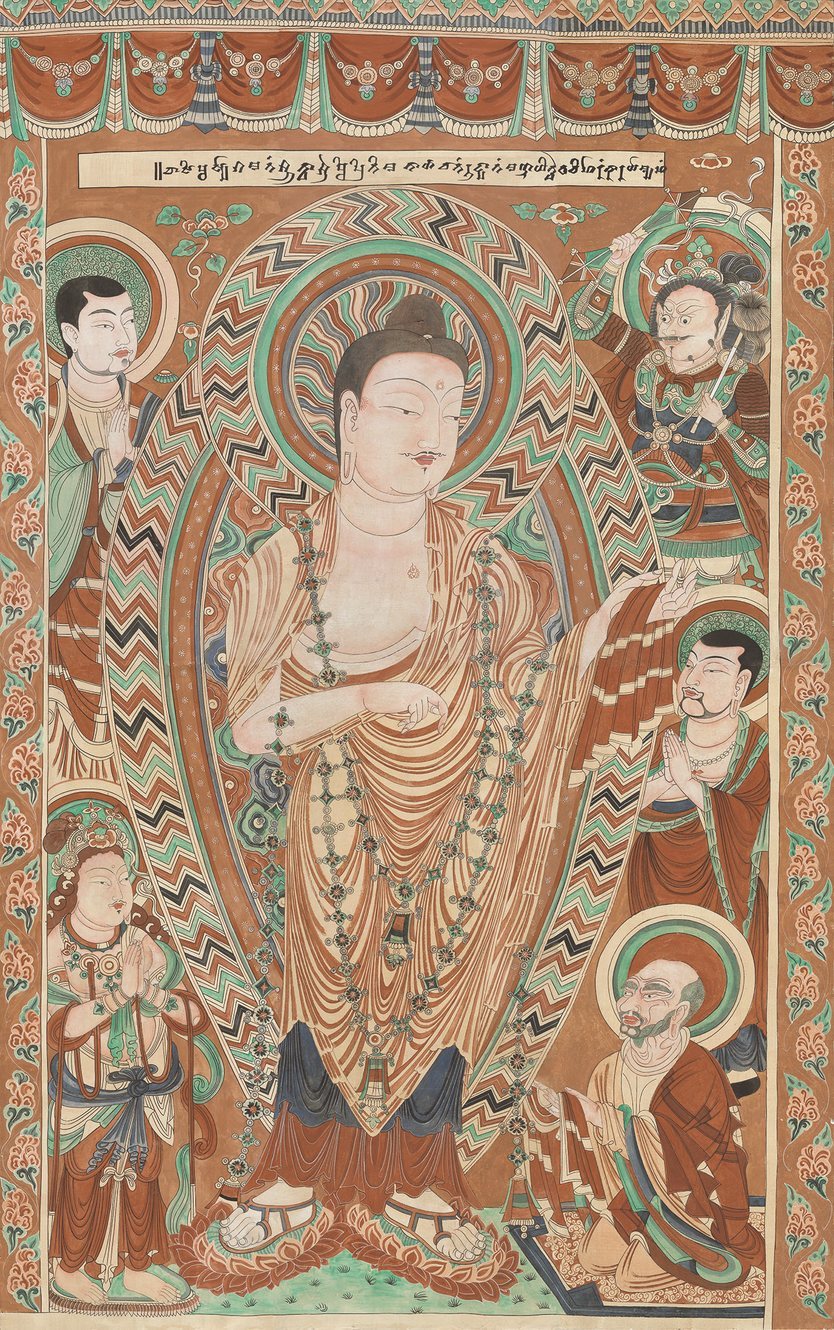
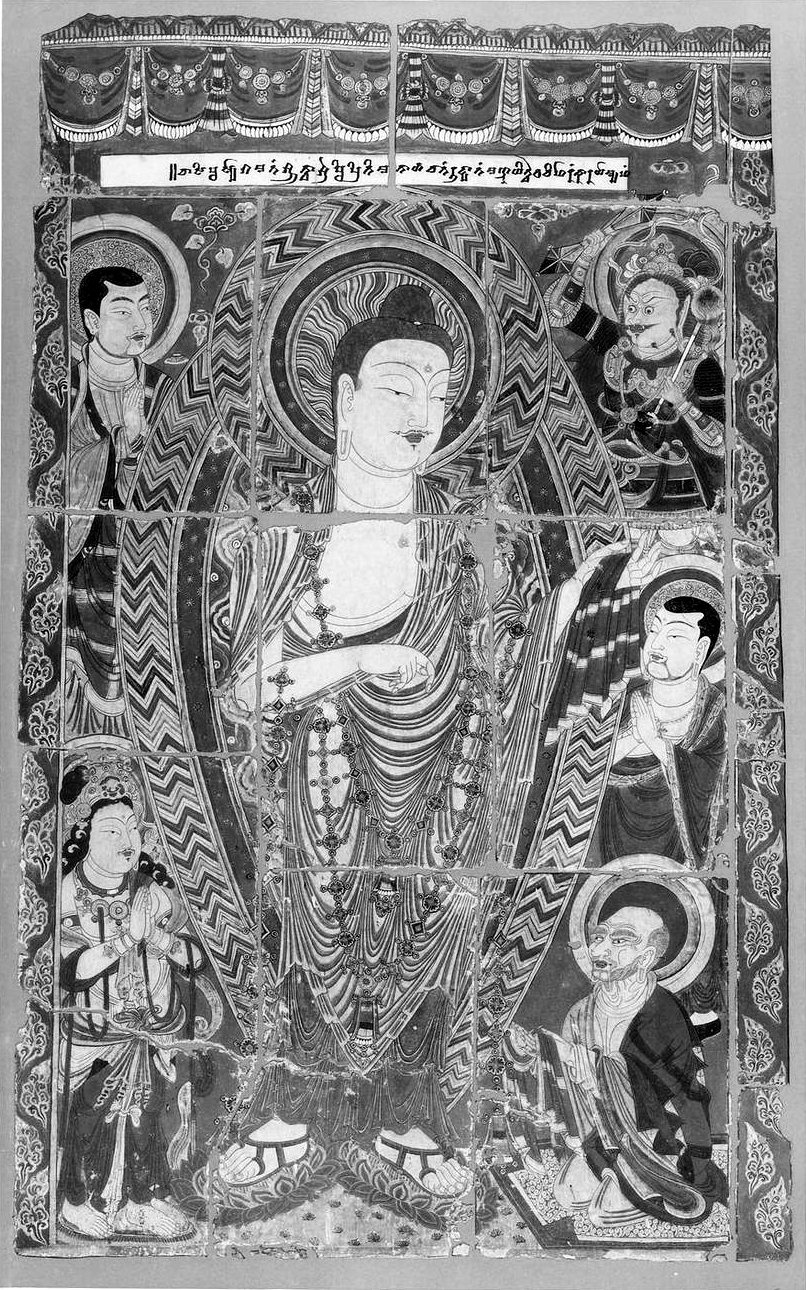
Facsimile of the original collotype plate
Reconstruction in natural mineral pigments
Hold and drag
Three connected histories · This timeline grows as the project continues